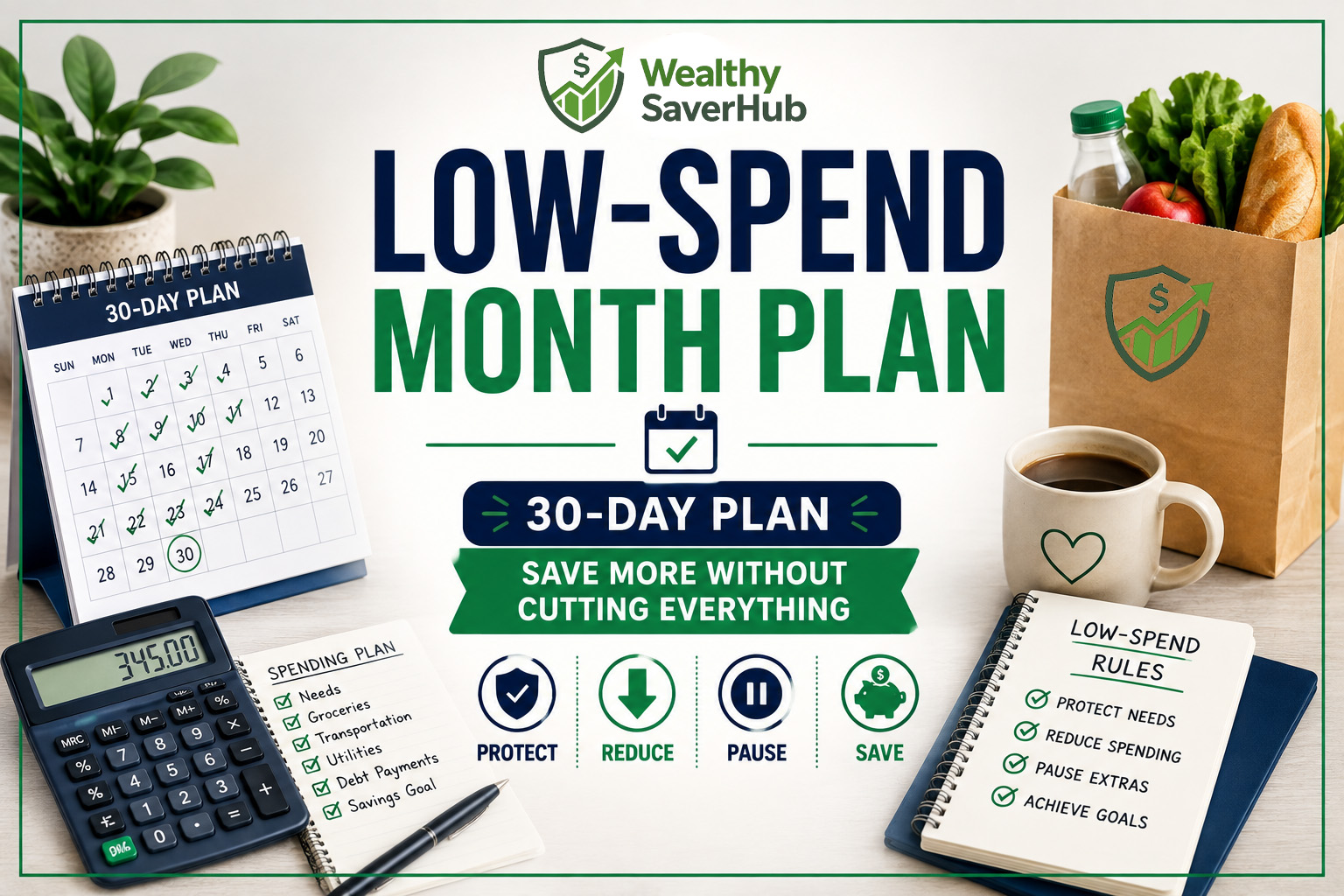
Low-Spend Month: A 30-Day Plan That Doesn’t Require Cutting Everything
Wealthy Saver Hub may receive compensation when readers use certain links. Compensation does not influence our educational content or editorial conclusions.
A low-spend month is one of the simplest ways to reset your money habits without trying to live like you spend nothing at all.
Instead of banning every purchase, you create rules that reduce nonessential spending for 30 days while still leaving room for real life. That means you keep paying for needs, planned obligations, and a few reasonable priorities, but you cut back on the spending that tends to happen automatically.
If you’ve tried a no-spend challenge and quit after a few days, this version may feel more realistic.

Quick Answer
A low-spend month is a 30-day plan to temporarily reduce nonessential spending so you can save more money, spot waste, and build better habits.
The easiest way to do it is:
- Pick one clear goal for the month.
- Decide which spending categories are allowed, limited, or paused.
- Track your progress weekly.
- Move the money you save into a separate savings account or sinking fund.
- Keep the best habits after the month ends.
The goal is not perfection. The goal is to spend more intentionally for one month and learn what is actually helping or hurting your budget.
What Is a Low-Spend Month?
A low-spend month is a short-term spending reset.
You still buy necessities such as housing, utilities, groceries, transportation, insurance, debt payments, and medical needs. What changes is how you handle the spending that is flexible.
That might include:
- restaurant meals
- impulse online purchases
- convenience spending
- entertainment add-ons
- extra subscriptions
- unused memberships
- last-minute shopping trips
- delivery fees and app purchases
Think of it as a budget tune-up, not a punishment.
Why a Low-Spend Month Works Better Than an Extreme No-Spend Challenge
A strict no-spend challenge sounds impressive, but many people quit because it is too rigid.
A low-spend month usually works better because it leaves room for:
- planned social spending
- basic family needs
- occasional flexibility
- realistic grocery shopping
- necessary transportation
- small quality-of-life choices you actually value
When people fail a money challenge, it is often not because they lack motivation. It is because the rules do not fit real life.
A low-spend month is more sustainable because it focuses on the purchases that are easiest to reduce without disrupting your whole life.
What You Should Protect, Reduce, and Pause
One of the smartest ways to build your rules is to separate your spending into three groups.
Low-Spend Month Decision Table
| Category | What it means | Examples |
|---|---|---|
| Protect | Keep spending as normal because these are needs or important obligations | rent, utilities, insurance, medication, minimum debt payments, basic groceries |
| Reduce | Spend, but with a lower limit or stricter plan | takeout, coffee, entertainment, rideshares, convenience purchases |
| Pause | Stop for the month unless there is a genuine reason to make an exception | impulse shopping, hobby spending, decor, non-urgent online orders, extra streaming add-ons |
This framework is more practical than trying to label every purchase as “good” or “bad.”
How to Set Up Your Low-Spend Month Before Day 1
A low-spend month works best when you prepare first.
1. Choose One Main Goal
Pick one goal that gives the challenge a purpose.
Examples:
- save $300 for an emergency fund
- free up money for a credit card payment
- prepare for back-to-school costs
- rebuild your checking buffer
- stop eating out so often
- cut online impulse purchases
A vague goal like “spend less” is hard to follow.
A clear goal like “save $250 this month for car repairs” is much easier to act on.
2. Review Last Month’s Spending
Look at your bank and card transactions from the past 30 days.
Ask:
- Where did small purchases add up?
- Which categories surprised me?
- What do I regret spending on?
- What spending felt useful or worth it?
You do not need perfect budgeting software to do this. A simple list is enough.
3. Create Your Rules
Good rules are specific.
Instead of saying:
- “I’ll try not to eat out as much”
Say:
- “I’ll eat out only once per week”
- “I’ll make coffee at home Monday through Friday”
- “I’ll pause clothing purchases for 30 days”
- “I’ll use what I already have before buying household extras”
4. Decide Where the Saved Money Will Go
This matters more than many people realize.
If the saved money stays in checking, it can disappear into other spending.
Choose a destination such as:
- emergency fund
- sinking fund
- travel fund
- holiday savings
- extra debt payment
- checking buffer
A Realistic 30-Day Low-Spend Month Plan
You do not need to overhaul everything in one day. A week-by-week approach is easier to follow.
Week 1: Stop the Easy Leaks
Your first week is about the spending that usually happens out of habit.
Focus on:
- pausing impulse online shopping
- deleting saved payment methods from shopping apps
- unsubscribing from promotional emails and texts
- skipping convenience-store extras
- making coffee or breakfast at home
- limiting food delivery
Week 1 action step:
Transfer a small amount to savings right away, even if it is only $25 or $50. Starting with an early win helps the month feel real.
Week 2: Tighten Grocery and Meal Spending
A lot of “budget blowups” happen in the food category, especially when groceries and takeout both run high.
This week, focus on:
- planning 5 to 7 simple meals
- shopping from a list
- using pantry and freezer items first
- choosing store brands where practical
- setting a takeout limit
- packing lunch more often
This does not mean buying the cheapest possible groceries. It means reducing waste and duplicate spending.
Week 2 action step:
Pick one “use what you have” night each week for leftovers, freezer meals, or pantry basics.
Week 3: Review Entertainment and Lifestyle Spending
By week three, the novelty of the challenge may wear off. This is often where people start slipping.
Now look at:
- streaming add-ons
- app renewals
- weekend spending
- casual shopping trips
- paid social outings
- hobby spending
- rideshare convenience
Instead of canceling everything, choose limits you can actually keep.
For example:
- one paid outing this week
- one movie night at home instead of going out
- no browsing shopping apps after 8 p.m.
- no same-day online purchases unless it is a need
Week 3 action step:
Create a list called “buy later” for non-urgent wants. If you still want the item after the month ends, revisit it then.
Week 4: Keep the Challenge Useful
The last week is not just about finishing strong. It is about figuring out which habits deserve to stay.
Review:
- what you saved
- which rules were easy
- which rules were unrealistic
- which categories still need work
- what changes you want to keep next month
A low-spend month is successful if it improves your habits, even if you do not follow every rule perfectly.
Week 4 action step:
Move the full amount saved into the goal you picked at the beginning of the month.
Example Low-Spend Month Savings
Here is a clearly labeled illustration of how a low-spend month might free up money.
Illustrative Savings Example
| Spending change | Typical monthly spending | Low-spend month spending | Estimated monthly savings |
|---|---|---|---|
| Coffee shop visits | $80 | $20 | $60 |
| Takeout and delivery | $180 | $80 | $100 |
| Impulse online purchases | $120 | $20 | $100 |
| Convenience snacks/drinks | $60 | $20 | $40 |
| Entertainment extras | $90 | $45 | $45 |
Estimated total savings: $345
Assumptions: This is an illustration only. Actual results will vary based on your spending habits, location, household size, and the rules you choose.
That is why a low-spend month can be powerful. The biggest results often come from a handful of repeated habits, not from one dramatic cut.

A Simple Low-Spend Month Rules Template
If you want a ready-made version, start here.
Example Low-Spend Month Rules
Allowed
- bills and fixed expenses
- basic groceries
- fuel or transportation needs
- medical needs
- essential household items
Reduced
- takeout to once per week
- coffee shop visits to once per week
- entertainment spending capped at $40
- personal spending capped at $50
Paused
- impulse online shopping
- clothing purchases unless necessary
- home decor and nonessential household extras
- hobby purchases
- beauty splurges
These are not universal rules. They are a starting point. Your version should match your budget and lifestyle.
How Much Could You Save in 30 Days?
If you want a quick estimate, use this simple method:
- List 3 to 5 categories you want to reduce.
- Estimate what you normally spend.
- Estimate a lower amount for the month.
- Subtract the difference.
- Add the savings together.
Quick Formula
Estimated low-spend month savings = usual spending − planned low-spend spending
Example:
- usual takeout: $150
- low-spend month takeout: $60
- savings: $90
Do that for multiple categories and you will get a realistic target.
Five Mistakes That Can Ruin a Low-Spend Month
1. Making the Rules Too Strict
If your plan removes every small pleasure, you may end up giving up halfway through.
2. Not Planning for Social Situations
A low-spend month should include a plan for birthdays, school events, weekends, or social invitations.
3. Forgetting Irregular Expenses
If your car registration, annual subscription, or school fee hits during the month, that is not necessarily failure. It may just be a reminder to build sinking funds.
4. Saving Nothing Up Front
When you wait until the end of the month to “see what is left,” the money often disappears.
5. Treating One Slip-Up Like Total Failure
A single restaurant meal or surprise purchase does not ruin the whole month. Reset and keep going.
Who a Low-Spend Month May Work Best For
A low-spend month can be especially useful if you:
- feel like money disappears without a clear reason
- want to build a starter emergency fund
- need a reset after overspending
- are preparing for a specific short-term expense
- want to lower lifestyle creep
- prefer flexible saving over strict budgeting
When a Low-Spend Month May Not Be the Best First Step
This challenge may be less helpful if:
- your budget is already extremely tight and mostly made up of essentials
- your financial problem is mainly low income rather than optional spending
- you are facing urgent bills you cannot cover
- you need a full budget plan, debt strategy, or income solution more than a short-term challenge
In those situations, a low-spend month can still help, but it may need to be part of a larger plan rather than the main solution.
A 30-Day Low-Spend Month Checklist
Use this as a simple action plan.
Before the month starts
- choose one savings goal
- review the last 30 days of spending
- decide what to protect, reduce, and pause
- set category caps
- create a place for the saved money to go
During the month
- track spending once or twice a week
- transfer saved money regularly
- use a grocery list
- pause impulse purchases
- keep a “buy later” list
- review your rules weekly
At the end of the month
- total your savings
- note the habits that worked best
- decide which rules to keep
- turn your best rule into a permanent habit
Frequently Asked Questions
What is the difference between a low-spend month and a no-spend month?
A no-spend month is usually stricter and aims to stop nearly all nonessential spending. A low-spend month reduces nonessential spending but still allows realistic flexibility.
How much can I save during a low-spend month?
It depends on your starting habits. Someone with frequent takeout, online shopping, and convenience spending may save more than someone whose budget is already very lean. Even saving $100 to $300 in one month can be meaningful if the challenge also improves your habits.
Can I still go out during a low-spend month?
Yes. Many people do better with a realistic limit instead of a total ban. For example, you might allow one paid social activity per week or set a monthly entertainment cap.
Should I stop all subscriptions during a low-spend month?
Not necessarily. Review them first. You may decide to cancel unused subscriptions, pause optional add-ons, or keep the ones you genuinely use and value.
What should I do with the money I save?
Move it to a specific goal, such as an emergency fund, holiday fund, travel fund, or extra debt payment. Giving the savings a job helps you keep it.
What if I mess up during the challenge?
That is normal. One off-plan purchase does not cancel the month. The best move is to continue, review what triggered the purchase, and adjust your rules if needed.
Is a low-spend month good for beginners?
Yes. It is often easier for beginners than a strict no-spend challenge because it teaches awareness and control without requiring perfection.
Bottom Line
A low-spend month works best when it feels realistic enough to finish.
You do not need to cut everything, stay home every weekend, or never spend a dollar on fun. You simply need a 30-day plan that helps you spend with more intention.
Start with a clear goal. Protect essentials. Reduce the categories that leak money. Pause the purchases that do not matter much. Then keep the habits that genuinely improve your finances.
That is how a one-month challenge can turn into longer-term savings progress.
Financial disclaimer
Financial disclaimer: This content is provided for general educational and informational purposes only. It does not constitute personalized financial, investment, tax or legal advice. Rates, fees, account terms and eligibility requirements can change. Verify current information directly with the relevant financial institution or qualified professional before making a financial decision.