How Much Should I Save Each Month? A Simple Calculator Guide
Wealthy Saver Hub may receive compensation when readers use certain links. Compensation does not influence our educational content or editorial conclusions.
If you are wondering, “How much should I save each month?” there is no single dollar amount or percentage that works for everyone.
A better approach is to look at your take-home income, essential expenses, current savings, financial goals, and the amount of time you have to reach those goals.
For example, saving 20% of income may be manageable for one household but unrealistic for another facing high housing, childcare, medical, or debt costs. Starting with $50 or $100 per month can still be meaningful if it is an amount you can consistently maintain.
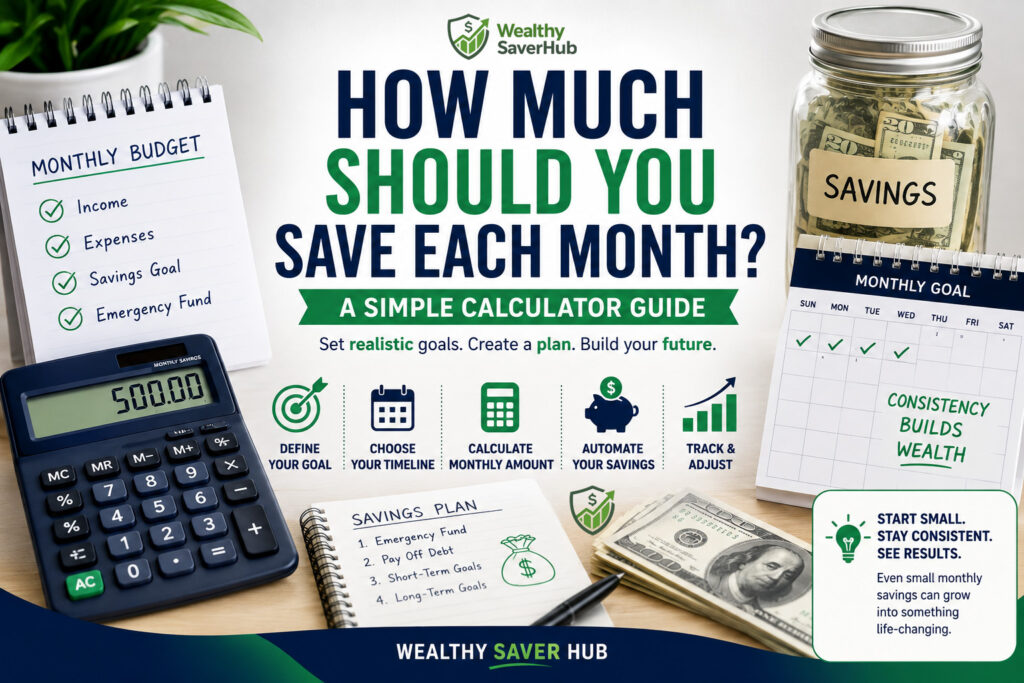
Quick Answer
A simple way to calculate how much you should save each month is:
Monthly savings needed = (Savings goal − Current savings) ÷ Number of months until your deadline
For example, if you want $6,000 in 12 months and are starting from $0:
$6,000 ÷ 12 = $500 per month
That calculation ignores interest, which makes it useful for quick planning.
You can also use a percentage of your take-home income as a reference point. The Consumer Financial Protection Bureau uses the 50/30/20 budget rule in educational materials as one example of a budgeting framework, with 20% allocated to savings. That does not mean everyone needs to save exactly 20%. Your personal target should fit your circumstances.
Monthly Savings Calculator Formula
You do not need a complicated financial formula to create your first monthly savings target.
Start with three numbers:
- Your target amount
- How much you already have saved
- How many months you have to reach the goal
Then use:
Monthly contribution = (Target amount − Current savings) ÷ Months remaining
Example: Saving $6,000 in One Year
Suppose:
- Target: $6,000
- Current savings: $0
- Timeline: 12 months
- Interest: ignored for this quick calculation
- Additional deposits: monthly
Calculation:
($6,000 − $0) ÷ 12 = $500
You would need to save approximately $500 per month.
If $500 does not fit your budget, the calculation is still useful. It tells you that something needs to change: the goal, timeline, monthly contribution, or a combination of the three.
How Much of Your Income Should You Save?
You may have heard recommendations to save a certain percentage of every paycheck.
A percentage can be a useful starting point, but it should not become a pass-or-fail test.
CFPB educational materials discuss the 50/30/20 rule, which divides a budget into 50% for needs, 30% for wants, and 20% for savings. CFPB also notes in its educational guidance that budgeting rules are not appropriate for every person and should be adapted to the individual’s financial situation.
Here is what several illustrative savings percentages look like at different take-home income levels.
Monthly Savings by Income: Illustrative Examples
| Monthly take-home income | Save 5% | Save 10% | Save 15% | Save 20% |
|---|---|---|---|---|
| $2,000 | $100 | $200 | $300 | $400 |
| $3,000 | $150 | $300 | $450 | $600 |
| $4,000 | $200 | $400 | $600 | $800 |
| $5,000 | $250 | $500 | $750 | $1,000 |
| $6,000 | $300 | $600 | $900 | $1,200 |
Illustration only: These percentages are examples, not recommended minimums or requirements.
Someone earning $4,000 after taxes who saves 10%, for example, would set aside $400 per month.
But the more important question is whether that $400 supports your goals without preventing you from paying necessary expenses.

A Practical Monthly Savings Framework
Instead of choosing a percentage because it sounds financially responsible, try this three-step framework.
1. Find Your Sustainable Minimum
Ask:
What amount could I realistically save every month, including an expensive month?
If the answer is $75, start with $75.
A smaller automatic contribution that continues every month may be more useful than setting an aggressive target and repeatedly abandoning it.
FDIC consumer guidance recommends identifying your savings goals and notes that regular automated deposits can help build emergency savings.
2. Calculate What Your Goals Require
Next, calculate how much you would need for specific goals.
For example:
| Goal | Target | Current savings | Timeline | Approx. monthly amount* |
| Starter emergency fund | $1,500 | $300 | 12 months | $100 |
| Vacation | $2,400 | $0 | 12 months | $200 |
| Car repair/replacement fund | $3,000 | $600 | 24 months | $100 |
| Larger cash goal | $10,000 | $2,000 | 18 months | $444.44 |
*Illustrative calculations ignore interest, fees, withdrawals, and changes to the savings target.
You may discover that your goals require more than your current budget can support.
That does not automatically mean the goals are impossible. You might extend a deadline, lower the target, redirect a windfall, increase income, reduce selected expenses, or prioritize one goal before another.
3. Increase Savings When Your Budget Allows
Your first savings amount does not have to be your permanent amount.
You could increase an automatic transfer after:
- paying off a recurring obligation
- receiving a raise
- reducing a monthly bill
- finishing another savings goal
- receiving irregular income you do not immediately need
For example, someone saving $100 monthly could increase it to $125 and later to $150 rather than attempting an immediate jump to $500.
Why Building Monthly Savings Matters
Regular saving creates financial room between an unexpected expense and the need to borrow.
The Federal Reserve’s 2025 Survey of Household Economics and Decisionmaking, released in May 2026, found that 63% of US adults said they could cover a hypothetical $400 emergency expense using cash or its equivalent. The share was unchanged from the previous three years.
That means a substantial portion of adults would need another method to deal with even a relatively modest unexpected expense.
The Federal Reserve also reported that common unexpected major expenses included vehicle repairs or replacement, home or appliance repairs, and medical expenses.
You cannot predict every expense, but regular monthly savings can make unexpected costs easier to handle.
Should Emergency Savings Come First?
For many beginners, building some accessible cash savings is a reasonable early priority.
An emergency fund can help with expenses such as:
- car repairs
- urgent home repairs
- medical bills
- temporary income loss
- unexpected travel
- essential appliance replacement
You do not have to build several months of expenses immediately.
A more manageable first target might be a specific dollar amount, followed by one month of essential expenses, and then a larger reserve over time.
Emergency Savings Ladder
Here is one way to break a large goal into smaller milestones.
| Stage | Example goal | Purpose |
| Stage 1 | $500 | Small unexpected costs |
| Stage 2 | $1,000 | Larger short-term cushion |
| Stage 3 | 1 month of essential expenses | Short income disruption |
| Stage 4 | Multiple months of essential expenses | Larger financial buffer |
These are illustrative milestones, not universal financial requirements.
Your appropriate emergency fund depends on factors including job stability, household size, insurance coverage, health needs, access to credit, and how predictable your expenses are.
The Federal Reserve tracks whether households have rainy-day funds capable of covering three months of expenses, but that measure is a survey benchmark rather than a rule that every household must follow.
Calculate Your Monthly Savings From a Specific Goal
Goal-based saving often gives you a clearer answer than simply saying, “I should save more.”
Suppose you want to build a $10,000 fund.
You already have $2,000, so your remaining gap is:
$10,000 − $2,000 = $8,000
You want the money in 18 months.
Ignoring interest:
$8,000 ÷ 18 = $444.44 per month
Your approximate target would therefore be $444.44 per month.
You might round that up to $445 or $450 for easier transfers.
What If the Account Earns Interest?
Interest can reduce the amount you personally need to contribute, but be careful about assuming a savings rate will remain unchanged.
Consider this clearly labeled hypothetical example:
- Starting balance: $2,000
- Target balance: $10,000
- Time: 18 months
- Illustrative APY: 4.00%
- APY assumed unchanged for all 18 months
- Deposits: end of each month
- Withdrawals: none
- Fees: excluded
Under those assumptions, the required monthly contribution would be approximately $425.66, rather than $444.44 without interest.
That does not mean you can currently earn or will continue earning a 4.00% APY. The rate is used only to demonstrate how interest can affect a savings calculation.
For planning a goal that absolutely must be reached by a specific date, using a conservative interest assumption—or ignoring interest—can reduce the risk of falling short if the account’s rate declines.
What If You Cannot Save the Calculated Amount?
Suppose your calculator says you need $500 each month but your budget only has room for $250.
That does not make the calculator useless. It gives you information you can act on.
You have four main levers:
Lower the Goal
A $6,000 target could become a $4,000 first-stage goal.
Extend the Timeline
Saving $6,000 over 24 months rather than 12 months reduces the simple monthly requirement from $500 to:
$6,000 ÷ 24 = $250 per month
Increase the Monthly Amount Later
You might begin at $250 and increase the contribution when your financial situation improves.
Add Occasional Extra Contributions
Tax refunds, bonuses, gifts, or other irregular income can supplement monthly savings when appropriate.
FDIC guidance specifically notes that windfalls such as tax refunds or work bonuses can be used alongside regular deposits to build emergency savings.
Saving a Fixed Amount vs. Saving a Percentage
Both methods can work.
| Method | How it works | May be useful when |
| Fixed dollar amount | Save the same dollar amount monthly | Income and bills are predictable |
| Percentage of income | Save a set percentage of each paycheck | Income changes from month to month |
| Goal-based amount | Calculate the amount needed by a deadline | You have a specific target |
| Hybrid approach | Save a minimum plus a percentage of extra income | Income is irregular |
A salaried worker might automate $300 every month.
Someone with variable income might instead save 8% of every payment, while maintaining a smaller minimum transfer during slower months.
Neither system is automatically better. The best method is one you can maintain while covering necessary expenses.
Use Take-Home Pay for a Simple Household Savings Rate
For a beginner-friendly monthly budget, using take-home pay can make the math easier because that is the money actually reaching your checking account after payroll deductions.
The formula is:
Monthly savings rate = Monthly amount saved ÷ Monthly take-home income × 100
Example
Take-home income: $4,500
Monthly savings: $450
$450 ÷ $4,500 × 100 = 10%
Your household cash savings rate in this example is 10%.
Be clear about what you include in the calculation.
If retirement contributions are deducted before your paycheck reaches your bank account, they will not appear in a calculation based only on take-home pay. You may therefore want to track cash savings and retirement contributions separately.
Where Should Monthly Savings Go?
The destination should match the purpose of the money.
Money you may need soon is different from money intended for retirement decades from now.
For an emergency fund or short-term savings goal, an accessible savings account may be appropriate.
FDIC insurance covers eligible deposit products at FDIC-insured banks. The standard insurance amount is $250,000 per depositor, per insured bank, for each account ownership category. Coverage depends on the institution, deposit product, ownership category, and other applicable requirements.
Federally insured credit unions have comparable federal share insurance administered by the NCUA, subject to NCUA coverage rules.
Remember that not every financial product sold by a bank or financial company is a federally insured deposit. Stocks, mutual funds, and other non-deposit investments are not covered by FDIC deposit insurance.
A 30-Day Plan to Start Saving Monthly
If calculating the “perfect” amount is delaying you from starting, use this simple plan.
Week 1: Review Your Numbers
Write down:
- monthly take-home income
- essential expenses
- recurring discretionary expenses
- minimum debt payments
- current savings
Consumer.gov recommends listing monthly income and expenses, subtracting expenses from income, and regularly reviewing the resulting budget. It also notes that savings can be treated as one of the items in your monthly budget.
Week 2: Choose One Goal
Start with one clearly defined goal.
Instead of:
“Save more money.”
Use:
“Save $1,200 for emergencies over 12 months.”
That immediately gives you a monthly target:
$1,200 ÷ 12 = $100
Week 3: Automate the Amount
If your cash flow is predictable, consider setting an automatic transfer shortly after payday.
Both the FDIC and CFPB have highlighted automatic transfers or deposits as a way to make regular saving easier.
Check your account balance and upcoming bills first so an automatic transfer does not cause an overdraft or leave too little money for necessary expenses.
Week 4: Review and Adjust
Ask:
- Was the amount affordable?
- Did I need to transfer money back?
- Can I increase it slightly?
- Is my goal still realistic?
The first number you choose is a starting point, not a lifetime commitment.
Five Questions Before Setting Your Monthly Savings Target
Use this checklist before deciding on a number.
1. What exactly am I saving for?
A specific purpose makes it easier to calculate how much you need.
2. When will I need the money?
The shorter the deadline, the higher the required monthly contribution.
3. How much have I already saved?
Subtract current savings from the target before calculating new contributions.
4. What amount can my budget support consistently?
Review actual expenses rather than choosing a percentage in isolation.
5. Can the goal or timeline change?
Flexible goals give you more options when monthly cash flow is limited.
Common Monthly Savings Mistakes
Choosing an Unrealistic Percentage
Saving 20% sounds attractive until the transfer forces you to move money back into checking every month.
A sustainable percentage is usually more useful than an impressive number that does not last.
Saving Without a Defined Goal
A goal gives the money a purpose and lets you measure progress.
Forgetting Irregular Expenses
Car insurance, annual subscriptions, holiday spending, school costs, home maintenance, and similar expenses can disrupt a monthly plan.
Consider creating separate savings categories for predictable but non-monthly expenses.
Counting an Uncertain Interest Rate as Guaranteed
Savings account APYs can change.
For a deadline-driven goal, do not rely on an unverified future rate.
Increasing Lifestyle Spending Every Time Income Rises
A raise can be an opportunity to increase savings before the additional income becomes absorbed into recurring spending.
How Much Should a Beginner Save Each Month?
A beginner does not need to wait until they can save hundreds of dollars.
If $25 per paycheck fits your current situation, starting there can create the habit and give you useful information about your budget.
You can then increase the amount.
For example:
- Months 1–3: $50 per month
- Months 4–6: $75 per month
- Months 7–9: $100 per month
- Months 10–12: $125 per month
Total saved during the year, excluding interest:
($50 × 3) + ($75 × 3) + ($100 × 3) + ($125 × 3)
= $150 + $225 + $300 + $375
= $1,050
The key is not that this particular progression is right for you. It demonstrates how gradual increases can still produce meaningful progress.
Frequently Asked Questions
Is saving 20% of my income enough?
It can be a useful benchmark, but there is no universal savings percentage that is right for every household. CFPB materials use 20% savings as part of one 50/30/20 budgeting framework. Your appropriate amount depends on income, expenses, debt, goals, and other financial obligations.
Is saving $500 a month good?
Saving $500 per month equals $6,000 per year before interest. Whether that is enough depends on what you are trying to achieve. Compare the amount with your emergency-fund target and other savings goals rather than judging it in isolation.
How much will I save if I put away $100 per month?
Ignoring interest, saving $100 every month produces:
- $1,200 after one year
- $3,600 after three years
- $6,000 after five years
These figures assume every monthly contribution is made and no money is withdrawn.
Should I save a fixed amount or a percentage?
A fixed amount can work well with stable income, while a percentage may be easier when income varies. You can also combine the two by setting a minimum monthly contribution and saving part of any additional income.
Should I save money if I have debt?
There is no single answer for every borrower. Keeping some accessible cash can help prevent a minor emergency from creating new debt, while the cost and terms of existing debts also matter. Consider the interest rate, minimum payments, emergency reserves, and your overall cash flow when deciding how to divide available money.
Should emergency savings be in checking or savings?
A separate savings account can help keep emergency money away from routine spending while preserving access when needed. If you use a bank account, confirm that the bank is FDIC-insured and that your deposit is within applicable insurance rules. Federally insured credit unions have separate NCUA share-insurance protections.
Does interest change how much I need to save monthly?
Yes. Interest can reduce the contributions required to reach a target, but the effect depends on the balance, APY, deposit timing, and time period. Because variable savings rates can change, use conservative assumptions for goals with firm deadlines.
What if I cannot save anything right now?
Start by reviewing your income and expenses rather than forcing a contribution that makes it harder to pay essentials. Even identifying a future starting amount or a small expense that can eventually be redirected into savings is progress toward a workable plan.
Bottom Line
The answer to “How much should I save each month?” is not automatically 10%, 15%, 20%, or any other universal percentage.
Start with your goal.
Subtract what you already have.
Divide the remaining amount by the number of months you have to save.
Then compare that target with your actual budget.
If the number is too high, adjust the goal, timeline, or contribution rather than abandoning the plan completely.
A monthly savings calculator is most useful when it gives you a number you can act on—not a number that makes your finances harder to manage.
Financial disclaimer: This content is provided for general educational and informational purposes only. It does not constitute personalized financial, investment, tax or legal advice. Rates, fees, account terms and eligibility requirements can change. Verify current information directly with the relevant financial institution or qualified professional before making a financial decision.